Sunday, June 10, 2012

Newly Released FBI “Domestic Terrorism” Training on Anarchists, Environmentalists, Show COINTELPRO Tactics

by Will Potter on May 29, 2012 Green is the New Red


Newly released FBI presentations show the flawed and misleading information the government is using to train agents to identify and investigate “domestic terrorist” groups such as “black separatists,” anarchists, animal rights activists, and environmentalists.

Among the more troubling portions of the training materials are warnings of activists using the Freedom of Information Act, engaging in non-violent civil disobedience, and gathering in coffee shops.


The domestic terrorism training materials were obtained through the Freedom of Information Act by the ACLU. They offer additional insight into a disturbing pattern of FBI activity misrepresenting political activists as “terrorists” and manufacturing “domestic terrorism threats” where none exist, akin to the notorious COINTELPRO program of J. Edgar Hoover.


Anarchists Are “Criminals Seeking an Ideology”

In presentations on “Anarchist Extremism,” the FBI warns:
– Anarchists are “Criminals seeking an ideology to justify their activities”
– Anarchists are “Not dedicated to a particular cause”
– Green anarchists believe “individuals should ‘get back to nature’”

Their meeting locations include “college campuses, underground clubs, coffee houses/ internet cafes.” Their criminal activity includes “Sleeping Dragons” (a form of civil disobedience in which people lock arms in PVC pipes).

Anarchists are also “paranoid / security conscious,” according to the presentation. This is an interesting observation coming from the FBI, considering there have been two recent cases where the FBI played a key role in infiltrating anarchist groups in order to orchestrate alleged terrorist attacks. In the Cleveland May Day arrests, and in the Chicago NATO arrests, the FBI trumpeted the arrest of “terrorists” that agents themselves tried desperately to create.

However, not all anarchists are engaged in these types of plots, the FBI acknowledges. They use a “variety of tactics” including “civil disobedience” (such as resisting home foreclosures, creating community gardens, and many other activities not mentioned by the bureau).

The FBI also warns that anarchists may have “crossover ideologies” including animal rights extremism and environmental extremism.


Animal rights / environmental extremism

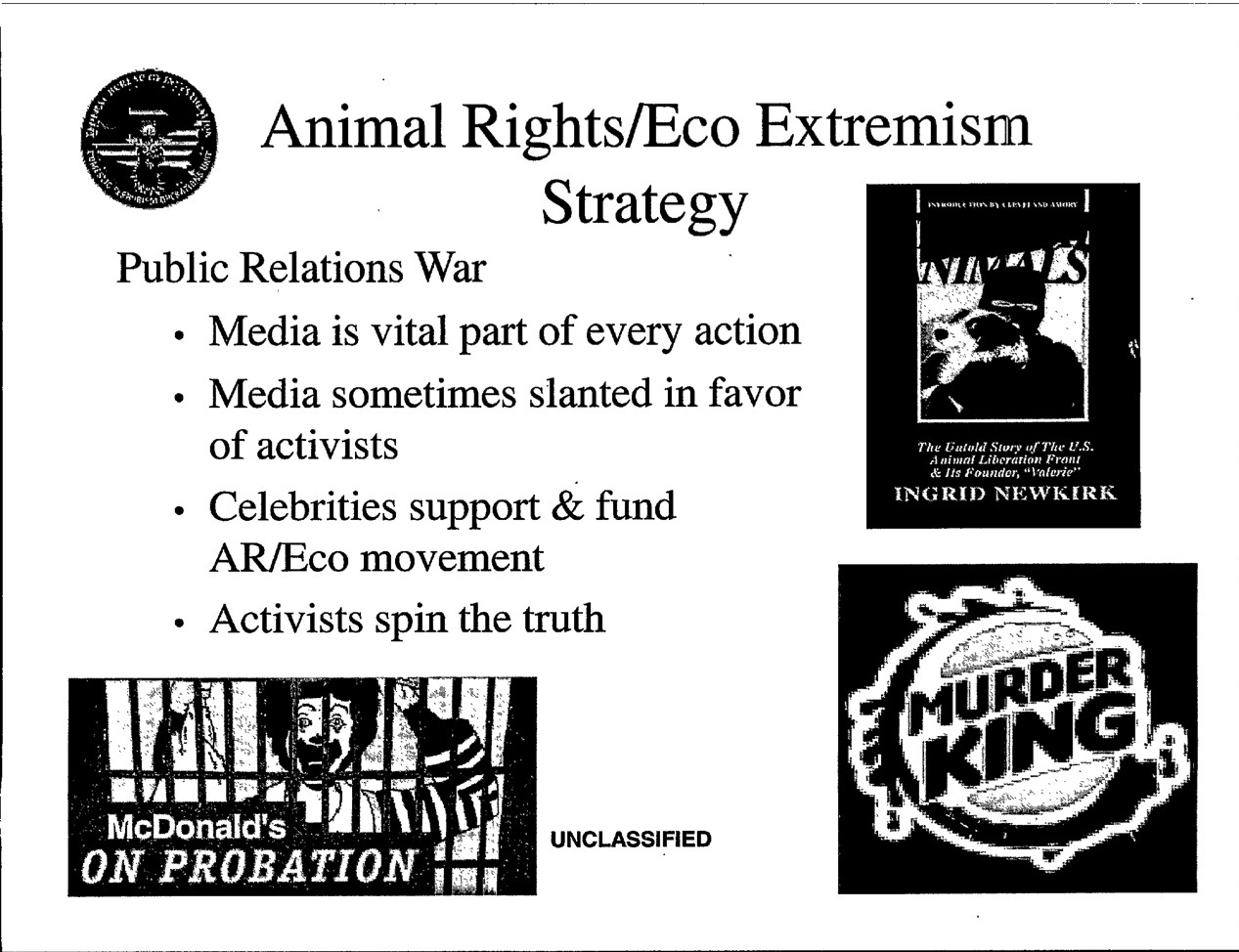
In the training presentation on these so-called “eco-terrorists,” the FBI lists lawful, First Amendment activity and low-level criminal activity (such as civil disobedience) as examples of domestic terrorism.

The FBI is particularly focused in these presentations on information gathering and what it calls a “public relations war” by activist groups. “Media is sometimes slanted in favor of activists,” the FBI says. “Activists spin the truth.”

Examples of information gathering listed by the FBI include requests for public documents under the Freedom of Information Act. In one presentation, FOIA requests are listed as examples of “University targeting.”

Elsewhere the FBI warns of “cold calls” and using “USDA Report [sic].”

The FBI also warns of activist attempts to use “false employment.” This is undoubtedly related to activists who seek employment at factory farms and vivisection labs in order to expose animal welfare abuses. As I have reported here previously, the FBI has considered terrorism charges for non-violent undercover investigators. And multiple states have been seeking to criminalize undercover investigations as well.

As I document in Green Is the New Red, there has been a slow and relentless expansion of “terrorism” rhetoric and investigations over the last 30 years. This type of language and FBI investigation was initially confined to property crimes by the Animal Liberation Front and Earth Liberation Front (groups that have caused millions of dollars in economic loss, but have never harmed a human being).

Now this already-broad terrorism classification has been expanded even further.  The Animal Enterprise Terrorism Act was drafted to target anyone who causes the “loss of profits” of an animal enterprise. The FBI acknowledges this shift in “terrorism” investigations in a slide that says the new law “alleviates the use of force or violence criteria.”


Relentless Expansion of “Domestic Terrorism”

The ACLU’s Mike German has an excellent dissection of the FBI’s “black separatist” documents. German writes:
Who are “Black Separatists” and is there any evidence they pose a terrorist threat?
Internet searches of “Black Separatist terrorism,” “Black Separatist bombing,” and “Black Separatist shooting” fail to bring up any recent incidents that could be fairly described as terrorist violence. No “Black Separatist” terrorist incidents are included in the FBI’s list of “Major Terrorism Cases: Past and Present,” nor on the more comprehensive list of terrorist attacks going back to 1980, which are detailed in an FBI report entitled “Terrorism 2002-2005.” While Black nationalist groups like the Black Panthers and the Black Liberation Army were certainly involved in political violence back in the 1970s, they no longer exist, and the last acts of violence attributed to either group were more than two decades ago.
So why are Atlanta FBI agents now searching for black separatist threats?   Because the FBI appears to be training them to believe there is one using factually flawed materials.

The FBI is targeting “black separatists,” anarchists, animal rights activists, and environmentalists in nearly identical methodologies. And these new documents show just how little these tactics change over time and between movements.

The FBI is manufacturing these “terrorism threats” through what I would call a process of conflation. Disparate groups are being conflated, across ideological and tactical divides, and presented as a united “threat.” For instance, the FBI notes that “black separatists” are a movement that “consists of multiple groups” lacking a unified ideology, but they are lumped together because they “all share racial grievances against the U.S., most seek restitution, or governance base [sic] on religious identity or social principals [sic].”

Just as the FBI invented a new class of domestic terrorists in 2009 called “American Islamic Extremists,” the FBI long ago embraced a new class of domestic terrorists called “eco-terrorists.” A wide range of groups, from the Humane Society to the Animal Liberation Front, have been conflated into this catch-all term. This use of language is essential to the demonization of entire social movements because it aides in reshaping them as an “other.” They are not individuals with specific political grievances, they become a mass of unreasonable extremist threats.

At the same time, the FBI is conflating a wide range of tactics. People who support anarchists or “black separatists” in their words are conflated with the very small group of people who have engaged in illegal activity. That’s how the FBI is including FOIA requests and civil disobedience as example tactics in a domestic terrorism presentation. Juxtapose this with the tactics of militia extremists and white supremacists, who have murdered, lynched, bombed, assaulted government officials and created weapons of mass destruction.

To most reasonable people, such a stark disparity between these groups would raise questions about how the FBI is allocating its domestic terrorism resources. How did such misguided policies come about?

These presentations point to one possible answer to that question: The FBI creates terrorism threats by directly training agents to believe they exist.

And Now They Are Coming For You

Tuesday, May 29, 2012 Modesto Anarcho
 
A Few Words from the Editors...

We live in an exciting time where it can be reasonably believed that the current ruling order can be overthrown and an entirely new world can flourish in it's place. Entire governments have been brought down, insurrections nurtured and pushed to their most subversive ends, and people across the globe anticipate a coming, perhaps winnable, clash between themselves and power. However, it is also a scary time to call yourself an anarchist, with the media and whole governments inflating fears of anarchist "terrorism," bomb-plots, and attacks. In recent months, 10 people have been brought up on conspiracy charges. Each of these cases is similar; an FBI informant finds young idealistic people involved on the periphery of protest movements and pushes them toward radical action, only to later arrest them after they have been pushed. In this special article from a comrade in the bay area, they discuss how strategies classically used against revolutionaries have come to be more broadly applied to other groups of people, as though they too are seen by the state as combatants and potential insurgents. 


Eric McDavid
In Modesto, we've already seen police target anarchists for repression, as was the case when the Stanislaus County Sheriffs launched a sting operation against an underground needle exchange in order to "rid the parks of anarchists and junkies," as head Sheriff Adam Christianson explained before the Board of Supervisors. In 2006, an Auburn anarchist, Eric McDavid, was sentenced to 20 years in prison after being entrapped by an FBI informant without even carrying out an action. While we have seen the state act against anarchists in this area, we also have seen the targeting of whole groups of people based on the neighborhood they live in or their immigration status. When the needle exchange was shut down, people reacted with solidarity: dropping banners, holding demonstrations, packing the courtroom, and throwing benefits to raise money, but what was our response when immigration officials raided a Modesto area flea market, carting away children under the pretext of looking for pirate DVDs? Where was the rage when the city of Modesto declared entire neighborhoods under gang injunctions, which in colonial fashion created curfews, forbade people from associating with each other, and hindered the movements of entire groups of people? 


We should not be surprised at state repression against radicals when such strategies are used by the government against huge segments of the population. Generalized surveillance, mass incarceration, the ubiquitous exploitation of migrant workers terrorized to silence through the constant threat of deportation, and gang injunctions which keep poor communities of color fractured and isolated are all part of a social war waged against the very population itself. With these first forays into the domestication of warfare into the every day fabric of our lives, is it any wonder that the state would target those who already proclaim themselves combatants in just such a war?


And Now They Are Coming For You


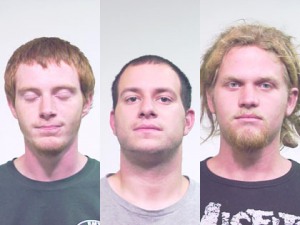
3 of the 5 people arrested after protests
in Chicago. 
The image of five men circulates through the news media and around the internet.  A few weeks later, a new story, this time the mugshots of three more men flash on the screen, followed by the pictures of two other men in the following days.

The ten white men are in serious trouble, something about “terrorism” from the sounds of it, but the situation is very confusing.  One thing is clear: informants were involved in all of these cases, and that they developed friendships with these young men in order to entrap them.

People in Ohio involved in FBI
entrapment case. 
In most of the cases it seems the men are charged with nothing more than talking, yet they are facing lengthy prison sentences.

How did we get to this point?

Background

Late 2002- 20,000 feet above the ocean a young man lies on the cold metal floor of an airplane, his arms and legs affixed to metal posts by sturdy canvass straps.  His captors speak a language he does not understand, yet they constantly scream at him, their mouths just inches from his face.  He is afraid.

The airplane lands somewhere outside of an Eastern European capital.  He is placed in a van and driven away from the makeshift airport.  They arrive at what appears to be a small office building on the outskirts of a city.
This place does not exist on any map.
Inside the building are not offices but 6 tiny damp cells.  The cells have no sinks or benches.  There is not even a toilet.   He is forced to the ground and, once again, his arms and legs are strapped down.
A hood is thrown over his head and he feels water running down his body.  His captors are yelling.  He cannot breathe. 
Guantanamo Bay 
In the past decade, thousands of Muslims have been subjected to the most disturbing forms of incarceration and interrogation imaginable.  Of those incarcerated, most were never officially charged.  Many did not survive the ordeal.
Extraordinary rendition, the extrajudicial abduction and international transport of a person for the purpose of interrogation, became commonplace during the “war on terror”.   Countless people who were never charged with a crime were transported to “black sites”.  The US government refuses to acknowledge the existence of many of these secret prisons. 
Like “indefinite detention” and “enhanced interrogation techniques”, “extraordinary rendition” is another euphemism used to downplay the campaign of terror waged by the US against the Muslim world.
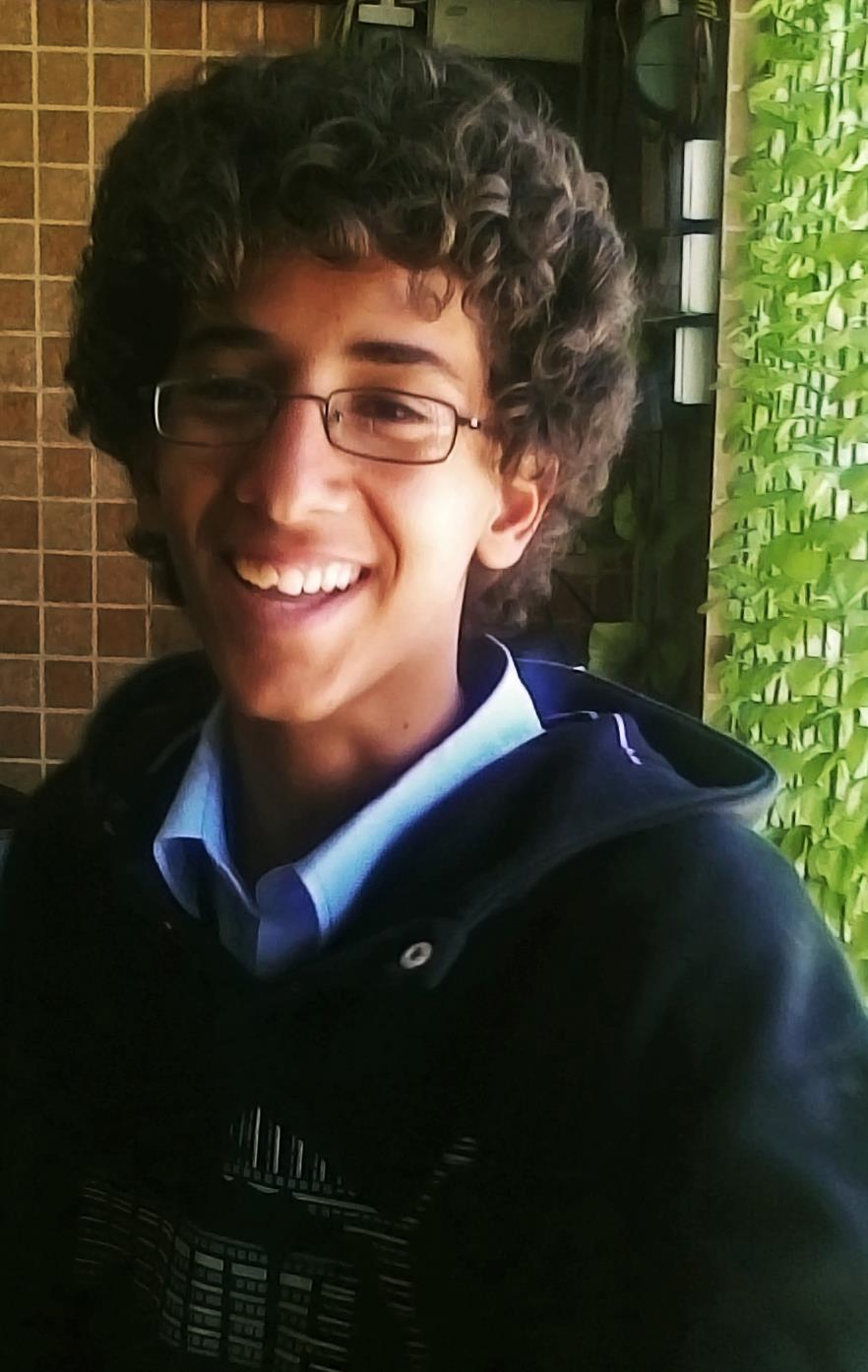
Abdulrahman al-Awlaki
Friday, October 14, 2011 -  A 16 year old American boy, along with nine others, is killed in a targeted CIA drone strike in Yemen. Abdulrahman al-Awlakibecomes the third American killed in Yemen by United States drones in just over two weeks.

These attacks made it clear that the most brutal methods, those aerial bombardments normally reserved for citizens of far-away lands, would now be used against Americansas well.
The targeted CIA murder of an American boy would normally cause an outrage. 
But he was Muslim, and we had grown to expect this.
It’s hard not to feel that we failed to respond appropriately to this decade long campaign of state repression, and that our failure to act then has helped to create the situation we are in today.
Drone planes carry out attacks and
conduct surveillance. 
Perhaps we didn’t understand how similar our struggles are.  Maybe we were susceptible to the reactionary media campaigns and thought that these young men from the Muslim world were the same men who burned women with acid in Pakistan or poisoned girls for learning to read in Afghanistan. Perhaps we convinced ourselves that, without knowing each individual’s politics, that they were all religious fundamentalists who wanted a return to an era of the most unbridled patriarchy.  Maybe believing this made it easier for us to ignore their persecution, perhaps it gave us an easier justification for our inability to act than to admit that we were afraid. 
It is now apparent that we ignored their struggle at our own peril.
The Precedent

Tarek Mehanna
Last month Tarek Mehanna was sentenced to 17 years in prison for translating communiqués issued by Muslim combatants.  This case is just another demonstration of the extreme racism of the judicial system.  But it has become apparent that the State is no longer content to suppress only ethnic minorities.  Any challenge to the system will now be met with the most brutal reprisal.
The prosecutions of animal and earth liberation militants from 2006 to 2009 was as much an attempt by the State to destroy those movements as it was a chance to set a precedent in the conviction of white Americans as terrorists.  Using the fear of the not-so-distant World Trade Center attack and the precedent of the convictions of countless Muslims for doing far less, the State successfully targeted another network of people.  They saw the animal and earth liberation movements as being marginal enough that they could be used as a testing ground for a campaign of persecution that is now aimed at all who disobey.
Somebody Snitchin’
Informants have been critical in the prosecution of nearly all terror cases.  We have been told that their role is to identify plots and to stop them before they are carried out. 
The role of the informant is to create a situation that justifies his existence.  An informant does not infiltrate a terror cell.  He creates one.
Many of us believed that informants target the key players of a movement in an attempt to remove influential people, thus striking a crippling blow. 
COINTELPRO targeted revolutionary
movements and groups in the 1960's-70's.
In the 1960s the FBI targeted the leaders of social movements for “neutralization”.  To cut off the head was to kill the body.  We learned from this and developed bodies that could function without a head.  No longer could they destroy us by targeting a few key people.
But they also learned.  Informants no longer look for leaders, they look for followers, those bright-eyed young idealists who will do anything to end this global cycle of suffering. 
Our diffuse structure has been met by a diffuse repression.  To target at random, to incarcerate the least threatening among us, sends a message that is much more terrifying than the old method. 
They no longer seek to decapitate a movement, but to slash wildly at its body so that none of its parts are safe. 
Today, there is nowhere to hide.
The Homefront
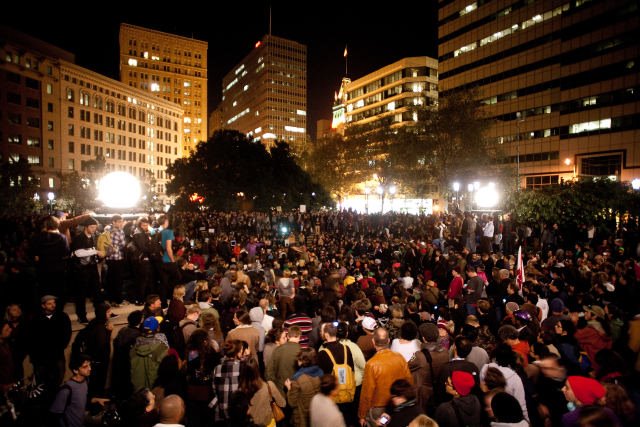
Occupy Oakland 
The Bay is the epicenter of struggle in this country.  We have almost grown used to the experience of small-scale uprisings.  We have participated in conflicts we never would have thought possible.
Around the country our allies have taken notice.  It is certain that the same is true of our enemies.
In Ohio, Minnesota, Washington, Illinois, even in small town Iowa the State’s secret messengers have reared their heads. 
But here they have remained silent.
The current wave of struggle in the Bay began three and a half years ago, and almost immediately evidence of informants was apparent.
At the height of the Oscar Grant movement we learned that the FBI expressed a great deal of interest in the anarchist tendency in the Bay.  It was uncovered that someone was feeding information about anarchist participation in the uprising to law enforcement.  It was suspected that this source was close to or within the anarchist movement.
This person was never discovered.
Around this time a strange figure appeared.  Claiming to be a leader of the “Oakland Panthers”, he publicly exalted the dumbest forms of violent action and considered macho homophobic yelling matches to be an admirable form of struggle.  He physically attacked people at random.  He was trusted by few.  It was revealed that he was a pimp who had worked as an informant for OPD in the recent past, and it was speculated that he still working for them.  3 years later he made an appearance at an Occupy Oakland action, trying to persuade a young anarchist to light something on fire.  He was outed and hasn’t been seen since.
We're already at that point...
It is apparent that law enforcement has, to some degree, used covert methods against radical movements in the Bay in recent times.  They have reason to fear the fighting force we have developed.  But, with the exception of a washed up pimp-turned fake Panther, none of the State’s messengers have been discovered.
Be safe.  There are enemies among us, though we have yet to identify them.
Learn from the cases of the ten men, and from all the prosecutions before them.  Be cautious about your use of the word “trust”.  Don’t let anyone drag you into a situation that you are not prepared for.
Organize your conspiracies carefully.  We must learn to strike harder and more effectively.  The anger we carry with us will one day bring down empires.
Until now the victims of the most brutal state repression have been the same people that have always had the boot on their neck. Though at times the police have clearly targeted people they believed to be white anarchists, the judicial system continued functioning in the same way it always has. In the past three and a half years of struggle in the Bay, nearly all of the people who have done time have been working-class black males.  
Media encourages people to call police on rioters and
looters after Oscar Grant revolt in Oakland.
For those of us who were raised to believe that, because of our race, we would be subjected to the full range of terror the State has to offer, this was not surprising.  In a sense, we do not react with the same emotion to these situations because we have grown to expect them.  That Muslims are indefinitely held in solitary confinement, that black youths fill the jails, we have come to believe that this is simply the order of things.
But this will soon change. 
The controlled management units, the sensory deprivation, the enhanced interrogation techniques, the indefinite detention, all the tools of the wars against populations abroad are coming home.
You watched as they tortured Muslims in Iraq, detained Mexicans in Arizona, incarcerated blacks in Oakland, and as you watched you thought to yourself this is fucked up. 
But you said nothing as they were thrown to the lions.
And now they are coming for you.

Further reading: 
The New State Repression - Ken Lawrence
Repression As State Strategy - A Murder of Crows

Two anarchists charged in pre-May Day vandalism

May 21, 2012 Seattle PI

Two Seattle residents accused of vandalizing the Moore Theater and several
other buildings prior to the May 1 protests are now facing felony charges.

King County prosecutors contend Kristin L. Sposito and Brian P. Greenwood
painted anarchist slogans on downtown buildings weeks before May Day, when
black-clad protestors smashed windows around downtown Seattle.

Writing the court, Deputy Prosecutor Benjamin Carr contended Sposito, 32,
and Greenwood, 30, caused about $14,400 in damage during a spray painting
spree in the early hours of April 16. Among their additions to the
cityscape, according to charging documents, were the slogans “Kidnap the
mayor” and “Burn (Expletive) Mayday!” as well as various anarchist
symbols.

According to charging documents, the vandalism was first discovered at
midnight by a garbage collector working near the Moore Theater.

The man spotted two vandals – since identified as Sposito and Greenwood –
spray painting “General Strike Mayday” and a circled letter A on an alley
wall of the theater, Detective Chris Young told the court. The pair ran as
the garbage collector called 911.

Minutes later, a security guard at an office complex in the 1300 block of
Second Avenue also spotted a man painting the anarchist symbol on that
building, the detective continued. A woman appeared to be acting as a
lookout; both fled after the guard spotted them.

A Seattle police officer patrolling the area stopped Sposito and Greenwood
just before 1 a.m. At the time, Greenwood was wearing a black mask over
his face.

Young told the court that both tried to run from officers. Sposito is
alleged to have dug her fingernails into the hand of one arresting
officer, and was brought to the ground and handcuffed.

Officers recovered two cans of spray paint from Greenwood’s backpack, and
noted Greenwood had bright green paint on his hands, the detective
continued. The paint matched graffiti found at several locations downtown.

The guard and trash collector identified both as the vandals, Young added.

Greenwood and Sposito, both of Seattle, have been charged with
first-degree malicious mischief and third-degree malicious mischief.
Neither is currently jailed in the case.

Return of the repressed; new days of rage for garment workers - and the disappeared...

May 27, 2012 Libcom.org
Ashulia factory fired - May 2012
After a long period of relative quiet, workers are again taking mass action in the Bangladeshi garment industry. Also; some comments on the recent wave of political 'disappearances'.
Since the deployment of the new Industrial Police Force (IPF) in 2010 struggles had been much reduced by the IP's innovative tactics(1). But recent events in Dhaka's industrial suburb of Ashulia and elsewhere suggest that workers' anger, solidarity, willingness to struggle and sheer weight of numbers can't be contained indefinitely.

Thursday, May 12th 2012, Ashulia, an industrial suburb of Dhaka; during the evening shift Salman, a store room worker at the Hameem Group factory, is reprimanded by a manager for using his mobile phone at work(2). The argument escalates into a physical fight. What happens next is unclear. According to police and management Salman was then taken to jail; it was reported matter-of-factly by several newspapers that;
According to the police...the director beat up Salman and handed him over to the police, they said. Ashulia police confirmed that he was sent in jail on Saturday.
http://www.thedailystar.net/newDesign/latest_news.php?nid=37659
But a different, even worse, version of events was soon to circulate amongst workers...
Saturday morning, May 14th, Hameem Group factory; Workers arrive at the factory to begin work. Seeing that Salman is still absent and hearing of the incident on Thursday, rumours spread that Salman was tortured to death by the managers and his body hidden. The workers gather in the factory, demanding to know what has happened to Salman - the Industrial Police arrive and begin trying to disperse the workers. The workers resist the cops and intense fighting breaks out. A store room is set ablaze and sweater machines are vandalised. By 10am the clashes spill out onto the main Dhaka-Tangail highway where police make repeated baton charges and workers respond with volleys of bricks, burn tires and block traffic.

The Hameem Group workers call out workers from neighbouring factories to join them; soon thousands of workers are fighting with police. The cops fire rubber bullets and tear gas. In the chaos, there are chases and counter-chases - in a crowd running away from a police charge a female garment worker, Nahar, 30, is hit by a bus and killed.

Workers begin attacking garment factory buildings along the highway, damaging 50 properties. Over 50 vehicles, 12 belonging to the Hameem Group, are also damaged. Fearing a contagious effect, 300 local factories stop production and send workers home - losing millions in lost production and adding to the mass of workers on the streets.

A police constable has a rifle snatched from him by a group of workers. Several TV crews are attacked and their cameras smashed, probably partly in response to recent use of film footage to identify rioters. Clashes continued until 1.30pm, by which time the area is swamped by cops and the Rapid Action Batallion para-militaries.

Apart from the dead worker, over 100 people are injured, including around a dozen cops and six journalists. Management of the Hameem Group estimate damage to the factory and machinery at Tk 10 crore (over $1 million).


(Protest footage starts at around 1.02 secs)

Sunday morning, 15th May; workers begin work in the Hameem Group factory but, with still no visible sign of Salman the vanished worker, soon stop and leave the factory. Gathering on the highway at 9am, they again quickly bring out nearby factories; 50,000 workers converge on the street. Fighting begins on the road, workers set afire tires and logs, blocking traffic. Another 100 people are injured, including workers, journalists, pedestrians and two police constables. A hundred teargas shells and 1000 rubber bullets are fired. Hundreds of factories are again closed for the day.
In an attempt to calm the situation Hameem management and police bring a 'Salman' to the factory. But the workers claim "This Salman is not our Salman" and, unconvinced, the unrest continues into the afternoon.

Eventually Hameem management are able to convene a meeting with the workforce where a return to work is agreed. Six arrested workers are released by police and the real Salman is apparently produced to the workers' satisfaction. The police rifle snatched by workers the previous day is recovered, found hidden under a pile of firewood.

Monday morning, Narayanganj, 10 miles south-east of Dhaka; workers protesting the illegal summary sacking of several co-workers agitate stop work at the Sinha Textiles factory. Hundreds of workers barricade the local highway and fight pitched battles with cops for two hours. Several other factories are vandalised.

Tuesday morning, Narayanganj; Sinha Textiles workers find themselves locked out and the factory under "indefinite closure". Though such dismissal without any advance warning is illegal it is a frequent occurrence. At 9am, as hundreds of workers demonstrate and fight cops for an hour, several vehicles are vandalised and a bus is torched.

While fleeing from police baton charges, another young female worker, 22-year-old Sonia, is killed when hit by a bus. 30 people, including 10 cops, are injured.

The 18 month 'truce' as both sides adjusted to the tactics of the new Industrial Police Force is well and truly over. The IPF tactics may even begin to backfire now by provoking a possible escalation; as workers begin to appreciate that their own levels of organisation, co-ordination, tactics and numbers involved must be sufficient to combat the now-greater organisation of the cops.
* * *

The Disappeared

Whichever of the two main parties are in power, every Bangladeshi parliamentary term of office tends to follow a predictable route, becoming ever more repressive. The present ruling Awami League's term is no different, though now somewhat worse than their recent predecessors, seemingly intent on crippling all organised opposition.

In the past two years there has been a wave of unexplained disappearances of dozens of political opposition figures. They have included local party activists of the Bangladeshi National Party(BNP), some more prominent BNP politicians and some student unionists. So far there only apparently been one disappearance due to activities related to labour struggles. Aminul Islam was a former garment worker; elected by workmates as a convenor on the Workers Representation and Welfare Committee at his workplace (the WRWC being the only form of minimal workforce representation allowed by bosses) he was sacked for his militancy. Helped with his legal case against his former employers by the Bangladesh Center for Worker Solidarity, a group that has argued for higher pay and better working conditions, he later became a union organiser for BCWS. The BCWS was active in the 2010 campaign for a minimum wage - since then its leading activists have suffered harassment, arrest, torture and legal frame-ups. Mr Islam was previously arrested by the security services in 2010 and tortured.

He was last seen alive in April 2012 in the industrial area of Ashulia, outside the BCWS offices, where the premises appeared to be under police surveillance. Receiving a phone call from a worker requesting help, he left home but never arrived at the agreed meeting place. His family filed a missing person report with police. Two days later his tortured body was found dumped by a roadside 100 kilometres away. The local police buried his remains as unclaimed and of unknown identity, but also had pictures of the corpse published in the press. These were seen by his friends and relatives, leading to the body being exhumed and positively identified. Signs of torture were obvious on Aminul Islam's body, with numerous wounds, bruises and broken bones.(3)

Whatever the routine official denials, nobody is under any illusions as to the state security services' role in these murders. While militant workers, rank'n'file labour activists and unionists have suffered harassment, arrest and torture, for the moment, at least, most disappearances continue to be of political activists related to the BNP;
In reply to a question posed by MP Tarana Halim in the Bangladesh parliament on March 14, minister of home affairs, Shahara Khatun, commented that most of the victims of enforced disappearances were affiliated with criminal groups and abducted by their rivals.
http://www.rediff.com/news/special/enforced-disappearances-on-the-rise-in-bangladesh/20120420.htm (our emphasis)
Minister Khatun expresses here either an unintentional or deliberately cynical sense of irony; the opposition BNP's history is every bit as corrupt and murderously repressive as the present Awami League regime - so in that sense his explanation is perfectly accurate.
NOTES
1) See; http://libcom.org/news/policemans-new-clothes-new-styles-repression-bangladeshi-garment-industry-12012012
2) Recent years have seen an explosion of mobile use in Bangladesh, now ranked 13th in the world for usage; https://en.wikipedia.org/wiki/List_of_countries_by_number_of_mobile_phones_in_use As they have become more affordable for workers no doubt they are being used to co-ordinate factory strikes and protests.
3) For more info on Islam's death; http://www.nl-aid.org/domain/human-rights/bangladesh-dgfi-tortured-to-death-labor-activist-aminul-islam/
Correspondence released by Wikileaks in 2010 revealed that the UK government had been training the para-military Rapid Action Batallion, notorious for its many assassinations; http://www.guardian.co.uk/world/2010/dec/21/wikileaks-cables-british-police-bangladesh-death-squad
While international criticism has led to a decline in RAB extra-judicial killings - with victims routinely reported as caught in "crossfire" - the state has merely replaced these with its tactic of disappearances. On the present wave; http://www.rediff.com/news/special/enforced-disappearances-on-the-rise-in-bangladesh/20120420.htm

Inside the FBI Entrapment Strategy

May 29, 2012
 
Over the past month, the FBI has initiated a spate of entrapment operations designed to frame anarchists as “terrorists.” Significantly, they have not targeted longtime organizers, but rather people who are relatively peripheral to anarchist communities.

In response, we’ve prepared a pamphlet suitable for a wide readership explaining how this entrapment strategy works, and an analysis exploring why the FBI has adopted it. Please circulate these widely.
Reading PDF [550kb]
Imposed PDF for Printing [550kb]


The Latest Trend in Repression

Not so long ago, it seemed that the FBI focused on pursuing accomplished anarchists: Marie Mason and Daniel McGowan were both arrested after lengthy careers involving everything from supporting survivors of domestic violence to ecologically-minded arson. It isn’t surprising that the security apparatus of the state targeted these activists: they were courageously threatening the inequalities and injustices the state is founded upon.

However, starting with the entrapment case of Eric McDavid—framed for a single conspiracy charge by an infiltrator who used his attraction to her to manipulate him into discussing illegal actions—the FBI seem to have switched strategies, focusing on younger targets who haven’t actually carried out any actions.

They stepped up this new strategy during the 2008 Republican National Convention, at which FBI informants Brandon Darby and Andrew Darst set up David McKay, Bradley Crowder, and Matthew DePalma on charges of possessing Molotov cocktails in two separate incidents. It’s important to note that the only Molotov cocktails that figured in the RNC protests at any point were the ones used to entrap these young men: the FBI were not responding to a threat, but inventing one.

Over the past month, the FBI have shifted into high gear with this approach. Immediately before May Day, five young men were set up on terrorism charges in Cleveland after an FBI infiltrator apparently guided them into planning to bomb a bridge, in what would have been the only such bombing carried out by anarchists in living memory. During the protests against the NATO summit in Chicago, three young men were arrested and charged with terrorist conspiracy once again involving the only Molotov cocktails within hundreds of miles, set up by at least two FBI informants.


Undercover informants “Mo” and “Gloves” (aka “Nadiya”)
from the NATO entrapment cases
 
None of the targets of these entrapment cases seem to be longtime anarchist organizers. None of the crimes they’re being charged with are representative of the tactics that anarchists have actually used over the past decade. All of the cases rest on the efforts of FBI informants to manufacture conspiracies. All of the arrests have taken place immediately before mass mobilizations, enabling the authorities to frame a narrative justifying their crackdowns on protest as thwarting terrorism. And in all of these cases, the defendants have been described as anarchists in the legal paperwork filed against them, setting precedents for criminalizing anarchism.

Why Entrapment? Why Now?

Why is the FBI focusing on entrapping inexperienced young people rather than going after seasoned anarchists? Isn’t that just plain bad sportsmanship? And why are they intensifying this now?
For one thing, experienced activists are harder to catch. Unlike anarchists, FBI agents work for money, not necessarily out of passion or conviction. Their reports often read like second-rate homework assignments even as they wreck people’s lives. Agents get funding and promotions based on successful cases, so they have an incentive to set people up; but why go after challenging targets? Why not pick the most marginal, the most vulnerable, the most isolated? If the goal is simply to frame somebody, it doesn’t really matter who the target is.

Likewise, the tactics anarchists have actually been using are likely to be more popular with the general public than the tactics infiltrators push them towards. Smashing bank windows, for example, may be illegal, but it is increasingly understood as a meaningful political statement; it would be difficult to build a convincing terrorism case around broken glass.

Well-known activists also have much broader support networks. The FBI threatened Daniel McGowan with a mandatory life sentence plus 335 years in prison; widespread support enabled him to obtain a good lawyer, and the prosecution had to settle for a plea bargain for a seven-year sentence or else admit to engaging in illegal wiretapping. Going after disconnected young people dramatically decreases the resources that will be mobilized to support them. If the point is to set precedents that criminalize anarchism while producing the minimum blowback, then it is easier to manufacture “terror” cases by means of agents provocateurs than to investigate actual anarchist activity.

Above all, this kind of proactive threat-creation enables FBI agents to prepare make-to-order media events. If a protest is coming up at which the authorities anticipate using brutal force, it helps to be able to spin the story in advance as a necessary, measured response to violent criminals. This also sows the seeds of distrust among activists, and intimidates newcomers and fence-sitters out of having anything to do with anarchists. The long-range project here, presumably choreographed by FBI leadership rather than rank-and-file agents, is not just to frame a few unfortunate arrestees, but thus to hamstring the entire anti-capitalist movement.

How to Destroy a Movement

As we saw in the Green Scare, FBI repression often does not begin in earnest until a movement has begun to fracture and subside, diminishing the targets’ support base. The life cycle of movements passes ever faster in our hyper-mediatized era; the Occupy phenomenon peaked in November 2011 and has already slowed down, emboldening the authorities to consolidate control and take revenge.
As anarchist values and practices become increasingly central to protest movements, the authorities are anxious to incapacitate and delegitimize anarchists. Yet in this context, it’s still inconvenient to admit to targeting people for anarchism alone—that could spread the wrong narrative, rallying outrage against transparently political persecution. Likewise, they dare not initiate repression without a narrative portraying the targets as alien to the rest of the movement, even if that repression is calculated to destroy the movement itself.

Fortunately for the FBI, a few advocates of “nonviolence” within the Occupy movement were happy to provide this narrative, disavowing everyone who didn’t affirm their narrow tactical framework. Journalists like Chris Hedges took this further by framing the “black bloc” as a kind of people rather than a tactic—despite even the Chicago Sun-Times comprehending the distinction. Hedges led the charge to consign those who actively defended themselves against state repression to this fabricated political category—in effect, designating them legitimate targets. It is no coincidence that entrapment cases followed soon after.


“The individuals we charged are not peaceful protesters, they are domestic terrorists,” [state attorney Anita] Alvarez said. “The charges we bring today are not indicative of a protest movement that has been targeted.”
 
The authorities swiftly took up this narrative. In a recent Fox News article advancing the FBI agenda, we see the authorities parroting Chris Hedges’ talking points—“they use the Occupy Movement as a front, but have their own violent agenda”—in order to frame the black bloc as a “home-grown terror group.” The article also describes the Cleveland arrestees as “Black Bloc anarchists,” without evidence that any of them have ever participated in a black bloc.

The goal here is clearly to associate a form of activity—acting anonymously, defending oneself against police attacks—with a kind of people: terrorists, evildoers, monsters. This is a high priority for the authorities: they were able to crush the Occupy movement much more quickly, at least relative to its numbers, in cities where people did not act anonymously and defend themselves—hence Occupy Oakland’s longevity compared to other Occupy groups. The aim of the FBI and corporate media, with the collusion of Chris Hedges and others, is to ensure that when people see a masked crowd that refuses to kowtow to coercive authority, they don’t think, “Good for them for standing up for themselves,” but rather, “Oh no—a bunch of terrorist bombers.”
To recapitulate the FBI strategy:

-divide and conquer the movement by isolating the most combative participants

-stage-manage entrapments of vulnerable targets at the periphery

-use these arrests to delegitimize all but the most docile, and to justify ever-increasing police violence.

What Comes Next

The authorities are explicitly announcing that there will be more of these “sting operations” at the upcoming Republican National Convention in Tampa. We can expect more and more “unsportsmanlike” entrapments in the years to come.

For decades now, movements have defended themselves against police surveillance and infiltration by practicing security culture. This has minimized the effectiveness of police operations against experienced activists. However, it can’t always protect those who are new to anarchism or activism, who haven’t had time to internalize complex habits and practices, and these are exactly the people that the FBI entrapment strategy targets.

Three years ago, we called for a collective security culture that could protect even newcomers against infiltrators. In a time of widespread social ferment, however, even this is not sufficient to thwart the FBI: we can’t hope to reach and protect every single desperate, angry,vulnerable person in our society. Infiltrators need only find one impressionable young person, however peripheral, to advance their strategy. These are inhuman bounty hunters: they don’t balk at taking advantage of any weakness, any need, any mental health issue.

If we are to protect the next generation of young people from these predators, our only hope is to mobilize a popular reaction against entrapment tactics. Only a blowback against the FBI themselves can halt this strategy. This will not be easy, but there is no better alternative.

Don’t stop speaking out, organizing, and fighting—that won’t stop them from repressing us or entrapping people. Retreating will only embolden them: we can only protect ourselves by increasing our power to fight back, not by withdrawing, not by hiding, not by behaving.

The best defense is a good offense. So long as capitalism is unstable—that is to say, until it collapses—there will be repression. Let’s meet it head on.

Further Reading

What Is Security Culture?
Towards a Collective Security Culture
Cleveland 5 Support Website
Lisa Fithian’s Experiences with FBI Informant Brandon Darby

Demo in Solidarity with Palestinian hunger strikers, Wednesday 30/5/12 at 20:00 in Haifa

May 29, 2012

English follow Arabic

لاسير محمود سرسك يدخل يومه ال 76 للاضراب عن الطعام وتدهور شديد في حالته
الصحيه .
معركة اسرانا البواسل في سجون الاحتلال ما زالت مستمره .

ندعوكم غداً الاربعاء لمظاهره في حيفا دعما لاسرانا الابطال
في تمام الساعه الثامنه على مفرق الكرمه-شارع الجبل، قبالة "بيت الكرمة" - حيفا
الاضراب مستمر ,نعم للجوع والف لا للركوع
***************

Mahmoud Sarsak - Football player, is held without charge and without trial
since he was arrested while trying to leave Gaza in 2009 (to go to play in
Balata). Now he is on the 76th day of his hunger strike, demanding to be
released, and there is immediate danger to his life. Join us tomorrow,
Wednesday 30/5, at 20:00, in Jabal street, Karma junction, (near Beit
Al-Karma - Beit Ha-Gefen)
for an emergency protest vigil.**************

Marie Mason and Eric McDavid Support Zines for June11th, 2012

May 27, 2012 Zinelibrary.info

Marie Mason support zine for June11th, 2012

Marie Mason has been involved in both environmental and labor struggles,
has edited many radical publications, and has been involved in water
rights, anti-infrastructure, anti-logging and anti- development projects
in the Midwest, organizing above ground and clandestinely for the past 30
years. She is a mother of two and companion to many wonderful animals, a
militant anarchist, and continues to be an involved member of each
community she’s lived in over the years.

This is the new zine that was distributed on the Never Alone Tour in the
lead up to June 11th, 2012.

http://zinelibrary.info/files/MarieZineCover.pdf


Eric McDavid support zine for June 11th, 2012

Eric McDavid is an environmental activist, a writer of zines, a
sometimes-poet and an almost always magician. He is a son, a brother, and
an uncle. He is an amazing partner (although, maybe the author is a bit
biased). He also happens to be an anarchist political prisoner.

This is the new zine that was distributed on the Never Alone Tour in the
lead up to June 11th 2012.

http://zinelibrary.info/files/Ericzine_cover.pdf